... so I'll cry if I want to.
The SWP Israel obsessives in the UCU have struck again. A bizarre resolution - "colleagues be asked to consider the moral and political implications of educational links with Israeli institutions" - has been passed after the, uncomfortably democratic, proposal to put it to a vote of the whole membership was defeated. It is worth reading really good posts by Eve Garrard, Jim Denham, Jon Pike, George Szirtes, and on Z Blog.
Resolution 25 bundles together a diffuse selection of items. For instance, it declares "criticism of Israel or Israeli policy are (sic) not, as such, anti-semitic". Indeed it is not necessarily so, but it can be - and frequently is. And the original boycott call was deemed discriminatory. On top of which, parts of the left have been rediscovering their dark tradition of anti-Semitic sentiment.
Then there is this line about the "apparent complicity of most of the Israeli academy". The logic is impeccable. As a British academic I can now expect a citizen's arrest from George Monbiot. I deserve no less. But then what about the academics from the Israeli left, supporters of peace and human rights? Hmm...
However, I really want to comment on Sally Hunt's defensive statement about the resolution,
I have to state that we have passed a motion to provide solidarity with the Palestinians, not to boycott Israel or any other country's academic institutions.
Well that is one interpretation, though all the measures are aimed at Israel and Israelis. I too have expressed my solidarity with the Palestinians in the past and I have long seen myself as pro-Palestinian, but I am utterly depressed by this constant, ignorant and utterly negative campaign.
There are two solutions to the conflict on offer - one-state and two-state. The one-state solution is largely the preserve of the Israeli and Palestinian nationalist right. It envisages a total victory for one side, denying the legitimacy of the other, often accompanied by calls for the removal of the bulk of their population. It is the politics of continuing conflict, of expulsion and extermination. The left favour a two-state solution, but of a particular kind.
Rather than envisage the division of the land into two hostile and separate entities, temporarily stabilising instead of ending the conflict, it sees that both the Palestinian and Israeli peoples' national histories are inextricably entwined. A progressive two-state solution is one that would build a constructive relationship between the two peoples and allow for a mutually supportive realisation of national self-determination. This is the painfully difficult politics of peace.
And it is in the advancement of a politics of peace where education can play a key role in helping develop collaboration and coexistence between both nations, of examining and addressing the distortions of history that infect their national narratives, of comprehending the lives of each community, of humanising the enemy. So what does the UCU do? It embraces the politics of conflict. Where is the support for organisations that work across the divide - e.g. IPCRI or One Voice? No mention even of Zochrot, an education project to translate the experience of the Palestinian Nakba into Hebrew. UCU act as if there was no Israeli left or peace movement with roots in Israeli academic institutions.
The present situation is indeed a Palestinian tragedy, simply read the ILO report on conditions in the Occupied Territories for confirmation. Will it be eased by this gesture politics, driven by a misconceived and ill-informed ideological project? Not one bit. The Palestinians need and deserve better.
UPDATE
Read Norm here
"While Motion 25 stands, the union is a tainted, a befouled, organization; it is a cesspit. It accommodates people who would treat their Israeli counterparts as pariahs. It should be held in contempt and shunned. The only good reason for anyone now to belong to UCU is to exert themselves to take it back from the boycotters and turn it into something better than a cesspit".
The only point of departure for me is that there are other purposes to membership. They are to take collective action to defend, for instance, adult education nationally and to deal with the sometimes difficult industrial relations we can face locally. I have a funny feeling that the proposers of Motion 25 couldn't give a toss about either.
Friday, May 30, 2008

They'll never run out of material
“I am upset by the use of therm ‘anoraks’ by Jennie Bond when a train set was sold. It gives a negative impression of people who have train sets and there is no need for it in my opinion. The term ‘anorak’ conjures up images of men who expose themselves in long trench coats and it is unfair to label people with train sets in this way.”
Just one item from the amazing spEak You're bRanes, a collection of real comments posted the BBC "Have Your Say" site. Cruel, but very funny. And don't miss the twat-o-tron, where you can generate your own words of wisdom.
Via Will and Olly
Just one item from the amazing spEak You're bRanes, a collection of real comments posted the BBC "Have Your Say" site. Cruel, but very funny. And don't miss the twat-o-tron, where you can generate your own words of wisdom.
Via Will and Olly
Wednesday, May 28, 2008

Filth and smut
On the whole I am in favour, and so I couldn't help baulking at the affectionate tone of the BBC drama depicting the campaigns of Mary Whitehouse. Given the impact of Whitehouse's driven fundamentalist moralism, I was reminded of Paulie's arguments in favour of representative democracy.
In particular, this from his latest is absolutely pertinent
I'd like an aggregated moral wisdom to prevail ... Yet we all piss and moan about paying a few hundred MPs, while tens of thousands of people work in lobbying, campaigning, wonking - earning a great deal more than MPs do in many cases. These people make their living from an attempt to disrupt that aggregated moral process.
And this is what she was about, trying to impose her conservative, Christian world view on a very different moral universe.
In particular, this from his latest is absolutely pertinent
I'd like an aggregated moral wisdom to prevail ... Yet we all piss and moan about paying a few hundred MPs, while tens of thousands of people work in lobbying, campaigning, wonking - earning a great deal more than MPs do in many cases. These people make their living from an attempt to disrupt that aggregated moral process.
And this is what she was about, trying to impose her conservative, Christian world view on a very different moral universe.
Tuesday, May 27, 2008
Beware - you may find this offensive
I certainly did. And, if he has been quoted correctly, it is an obscenity.
Working class people have lower IQs than those from wealthy backgrounds and should not expect to win places at top universities, an academic has claimed.
Great, he has just trashed all my working experience and the research of many others working in University Lifelong Learning. So, talent is distributed according to wealth is it? He has written off a whole class, teeming with wasted ability, as inferior. But then you don't have to look at your own prejudices and practices if you believe that do you? Very convenient.
Hat tip Will
UPDATE
George Szirtes joins the fray
Working class people have lower IQs than those from wealthy backgrounds and should not expect to win places at top universities, an academic has claimed.
Great, he has just trashed all my working experience and the research of many others working in University Lifelong Learning. So, talent is distributed according to wealth is it? He has written off a whole class, teeming with wasted ability, as inferior. But then you don't have to look at your own prejudices and practices if you believe that do you? Very convenient.
Hat tip Will
UPDATE
George Szirtes joins the fray
Just in case you were tempted ...
... to think the Tories might be OK after all:
A future Conservative government will bring in "boot camps" for unemployed young people aged between 18 and 21 who refuse to take a job, Chris Grayling, the party's welfare spokesman, will say tomorrow.
Hmm... where is "hug a hoodie" now? Instead it is "bring back the workhouse".
The hardening of Tory attitudes towards the unemployed will be combined with much tougher polices than Labour to get single parents and the disabled back to work, and a big move to privatise provision to help the unemployed.
Please, please New Labour. Don't decide to copy them.
A future Conservative government will bring in "boot camps" for unemployed young people aged between 18 and 21 who refuse to take a job, Chris Grayling, the party's welfare spokesman, will say tomorrow.
Hmm... where is "hug a hoodie" now? Instead it is "bring back the workhouse".
The hardening of Tory attitudes towards the unemployed will be combined with much tougher polices than Labour to get single parents and the disabled back to work, and a big move to privatise provision to help the unemployed.
Please, please New Labour. Don't decide to copy them.
Sunday, May 25, 2008
Crewe cut
The knives are out for Brown after the Crewe byelection, but doubts about the wisdom of change are also being expressed. Nick Cohen, for example, doesn't "think a palace revolution would help", being another example of cynical, elite rule rather than an expression of democracy. Andrew Rawnsley sees the Labour Party as being "emotionally poised between fatalism and panic" and rightly points to the key factor as being the renewed credibility of the Tories.
One thing is clear, the last change of leader isn't going to go down as a howling success. But there is an obvious reason. The point of change is change, not continuity. No one could claim that Thatcher's replacement with John Major was about introducing charisma to the premiership. Instead, he scrapped the Poll Tax, used more emollient language and won the next election, having removed the key cause of anger against the government. Labour needs more than personnel changes but a change of direction, philosophy and political economy. And it needs these changes in areas that directly impact on the lives of ordinary people - like equality.
Try saying to a postal worker that equality is an abstract principle when, with Royal Mail's decline and pensions crisis, they face losing their jobs and can read news like this,
Royal Mail's chief executive, Adam Crozier, will receive a near-£2m payment this summer under the company's long-term incentive plan, according to the annual report published yesterday.
The performance-related payment covers the three years from 2005 to 2008 and is on top of Crozier's annual remuneration, excluding incentive plans and pension contributions, of over £1m for last year.
Many of us can see the increasing rewards brazenly given to managers by themselves, regardless of their effectiveness. We do not feel envy; we have a sense of gross injustice. And Labour, if it rediscovers its commitment to egalitarianism as a guiding principle, may begin to seem once again like a party that speaks for us. And who knows, though the hour is perilously late, we may even vote for it.
One thing is clear, the last change of leader isn't going to go down as a howling success. But there is an obvious reason. The point of change is change, not continuity. No one could claim that Thatcher's replacement with John Major was about introducing charisma to the premiership. Instead, he scrapped the Poll Tax, used more emollient language and won the next election, having removed the key cause of anger against the government. Labour needs more than personnel changes but a change of direction, philosophy and political economy. And it needs these changes in areas that directly impact on the lives of ordinary people - like equality.
Try saying to a postal worker that equality is an abstract principle when, with Royal Mail's decline and pensions crisis, they face losing their jobs and can read news like this,
Royal Mail's chief executive, Adam Crozier, will receive a near-£2m payment this summer under the company's long-term incentive plan, according to the annual report published yesterday.
The performance-related payment covers the three years from 2005 to 2008 and is on top of Crozier's annual remuneration, excluding incentive plans and pension contributions, of over £1m for last year.
Many of us can see the increasing rewards brazenly given to managers by themselves, regardless of their effectiveness. We do not feel envy; we have a sense of gross injustice. And Labour, if it rediscovers its commitment to egalitarianism as a guiding principle, may begin to seem once again like a party that speaks for us. And who knows, though the hour is perilously late, we may even vote for it.
Saturday, May 24, 2008
It wasn't art
And it certainly wasn't good taste. However, it was the second musical I have enjoyed. Eurobeat is a wild send-up of the Eurovision Song Contest. It keeps the formula and then slips over the narrow borderline between the naff and the ridiculously surreal. It is hysterical.
The show centres around a contest between ten of the worst songs I have ever heard, performed superbly, with neat touches of comic ineptitude, and accompanied by dazzlingly choreographed and utterly misconceived dance routines. At each performance the winner is decided by the audience's mobile phone votes. Last night at the Lowry in Salford victory went to 'Estonia' with an inspirational song about 'pulling hard' and 'coming together', with dancing businessmen who then launch into a homo-erotic routine (yep, that is the level of the humour).
The bonus was the 'half-time' song and dance spectacular. Shame it wasn't in the competition. Any song sung by a woman dressed as a turnip and that rhymes 'smorgasbord' with 'that the lower middle class can afford' would have my vote.
I am still laughing. The show was so funny it could have been the real thing.
The show centres around a contest between ten of the worst songs I have ever heard, performed superbly, with neat touches of comic ineptitude, and accompanied by dazzlingly choreographed and utterly misconceived dance routines. At each performance the winner is decided by the audience's mobile phone votes. Last night at the Lowry in Salford victory went to 'Estonia' with an inspirational song about 'pulling hard' and 'coming together', with dancing businessmen who then launch into a homo-erotic routine (yep, that is the level of the humour).
The bonus was the 'half-time' song and dance spectacular. Shame it wasn't in the competition. Any song sung by a woman dressed as a turnip and that rhymes 'smorgasbord' with 'that the lower middle class can afford' would have my vote.
I am still laughing. The show was so funny it could have been the real thing.
Friday, May 23, 2008
Exodus ...
Movement of Hull people.
It has started. Driving to Manchester this weekend for the bank holiday, the motorway was more crowded than usual with cars decked in amber and black heading for Wembley. Tomorrow it will be heaving. A hand-made banner hangs from a bridge over the A63; "Will the last one out please switch off the lights".
I am not a City fan, though I have been a few times since I moved to Hull. My football highlight of the year was the agonising triumph on Wednesday. Hull, though, is on a high at the prospect of the Premiership. Tickets are near unobtainable after fans queued overnight. And I look back to my first visits to a crumbling Boothferry Park to watch a bottom division side play unimaginably dreadful football in front of scarcely 3,000 fans and wonder at the transformation.
Hull is a city divided between East and West. This is matched by the bitter rivalries of the rugby league sides, Hull Kingston Rovers in the East and Hull FC in the west. There is only one major football club though and so the city is united and alive ahead of tomorrow.
Good luck City, never in their history in the top division, this might be their year.
UPDATE
They did it
It has started. Driving to Manchester this weekend for the bank holiday, the motorway was more crowded than usual with cars decked in amber and black heading for Wembley. Tomorrow it will be heaving. A hand-made banner hangs from a bridge over the A63; "Will the last one out please switch off the lights".
I am not a City fan, though I have been a few times since I moved to Hull. My football highlight of the year was the agonising triumph on Wednesday. Hull, though, is on a high at the prospect of the Premiership. Tickets are near unobtainable after fans queued overnight. And I look back to my first visits to a crumbling Boothferry Park to watch a bottom division side play unimaginably dreadful football in front of scarcely 3,000 fans and wonder at the transformation.
Hull is a city divided between East and West. This is matched by the bitter rivalries of the rugby league sides, Hull Kingston Rovers in the East and Hull FC in the west. There is only one major football club though and so the city is united and alive ahead of tomorrow.
Good luck City, never in their history in the top division, this might be their year.
UPDATE
They did it
Thursday, May 22, 2008
3MA
That's three traditional musicians from three Francophone African countries - Madagascar, Mali and Maroc - Rajery, Ballake Sissoko and Driss El Maloumi. My friend and comrade in stoutness, the writer Roy Bainton, has sent me a wonderful CD of their music, a marvellous fusion of different styles. Here's a taste of them in concert.
Wednesday, May 21, 2008
Pride in adult learning
I'm on firmer ground with this comment related to the Eagleton article I posted on immediately below. At the start, he chucked in an extremely irritating throwaway remark about Raymond Williams' choice of career;
... adult education, a vocation he chose, along with New Left colleagues Richard Hoggart and EP Thompson, for political motives. In a rare moment of disillusion, he told me that the difference between teaching adults and students in the 1950s was like "teaching doctors' daughters rather than doctors' sons".
Eagleton's decision to give prominence to an anecdotal and admittedly "rare moment of disillusion" seems indicative of his own reservations, rather than Williams', and shows him embracing a stereotypical view of adult education, presumably because it failed to serve a declared political purpose instead of an educational one.
That said, any stereotype has a grain of truth and as university adult education, in particular, slipped into the post-war complacency of the 'Great Tradition' and 'education for the already educated,' it did become very middle class. But whose fault was that? It is no good radicals bemoaning the social make up of their students when all they do is advertise a course with a pretentious title and wait for thousands of horny handed sons of toil to queue up at the door begging for enlightenment. Any half decent adult educator will tell you that you have to work at it. You have to popularise, become accessible without being patronising, break down barriers, respect your students and value what they can contribute and, above all, you have to go to where the people are, rather wait for them to come to you.
And this brings me to the one article this week that reaffirmed my pride in my vocation and in the department I work in. I would urge everyone to read in full this report on offender learning, mainly based in Hull Prison, and see just what adult education can really achieve.
In it you can find everyday accounts of the casual cruelty that permeates the system, like the young offender with a love of animals and a knack of caring for them who was given a work placement in an abattoir.
You can find the effectiveness of education in fuelling resistance, as one ex-prisoner commented:
You can’t beat the prison system with violence, because they just use more force against you. I’d already had that experience; that had been my way. But if you can beat the prison system by using the law then obviously you know it’s a powerful weapon… If they recognise that you’ve got intelligence then they actually fear you. It turned out that the prison system feared me more for my lawful pursuits than they ever did for my unlawful pursuits.
You can read about the redemptive power of adult learning, through Graham who served nine and a half years for attempted murder and fraud and is now a teacher. Contrary to the way many teachers feel today, he finds teaching "better than a life of crime, that's for sure".
And you can read about the continuing prejudice that holds ex-offenders back:
At several points during our meeting, George is almost overwhelmed by emotion. “I’ve been out of jail five years now, and I thought somebody might have given me a chance by now, but they haven’t. I just don’t want it to have been all for nothing, because I feel like I’ve got so much to offer, you know?”
This is the kind of activity you have to engage in if you want to do more than teach courses to the daughters of doctors. It is difficult, frustrating and incredibly rewarding.
However, Eagleton also added that Williams
... never doubted that any Labour government worth its salt would invest massively in "institutions of popular culture and education", and lambasted them all, from Attlee to Wilson, for failing to do so.
We have a Labour government, one that has been in power for eleven years, and adult education is reeling, in crisis, and much of it is severely threatened. He must be spinning in his grave.
... adult education, a vocation he chose, along with New Left colleagues Richard Hoggart and EP Thompson, for political motives. In a rare moment of disillusion, he told me that the difference between teaching adults and students in the 1950s was like "teaching doctors' daughters rather than doctors' sons".
Eagleton's decision to give prominence to an anecdotal and admittedly "rare moment of disillusion" seems indicative of his own reservations, rather than Williams', and shows him embracing a stereotypical view of adult education, presumably because it failed to serve a declared political purpose instead of an educational one.
That said, any stereotype has a grain of truth and as university adult education, in particular, slipped into the post-war complacency of the 'Great Tradition' and 'education for the already educated,' it did become very middle class. But whose fault was that? It is no good radicals bemoaning the social make up of their students when all they do is advertise a course with a pretentious title and wait for thousands of horny handed sons of toil to queue up at the door begging for enlightenment. Any half decent adult educator will tell you that you have to work at it. You have to popularise, become accessible without being patronising, break down barriers, respect your students and value what they can contribute and, above all, you have to go to where the people are, rather wait for them to come to you.
And this brings me to the one article this week that reaffirmed my pride in my vocation and in the department I work in. I would urge everyone to read in full this report on offender learning, mainly based in Hull Prison, and see just what adult education can really achieve.
In it you can find everyday accounts of the casual cruelty that permeates the system, like the young offender with a love of animals and a knack of caring for them who was given a work placement in an abattoir.
You can find the effectiveness of education in fuelling resistance, as one ex-prisoner commented:
You can’t beat the prison system with violence, because they just use more force against you. I’d already had that experience; that had been my way. But if you can beat the prison system by using the law then obviously you know it’s a powerful weapon… If they recognise that you’ve got intelligence then they actually fear you. It turned out that the prison system feared me more for my lawful pursuits than they ever did for my unlawful pursuits.
You can read about the redemptive power of adult learning, through Graham who served nine and a half years for attempted murder and fraud and is now a teacher. Contrary to the way many teachers feel today, he finds teaching "better than a life of crime, that's for sure".
And you can read about the continuing prejudice that holds ex-offenders back:
At several points during our meeting, George is almost overwhelmed by emotion. “I’ve been out of jail five years now, and I thought somebody might have given me a chance by now, but they haven’t. I just don’t want it to have been all for nothing, because I feel like I’ve got so much to offer, you know?”
This is the kind of activity you have to engage in if you want to do more than teach courses to the daughters of doctors. It is difficult, frustrating and incredibly rewarding.
However, Eagleton also added that Williams
... never doubted that any Labour government worth its salt would invest massively in "institutions of popular culture and education", and lambasted them all, from Attlee to Wilson, for failing to do so.
We have a Labour government, one that has been in power for eleven years, and adult education is reeling, in crisis, and much of it is severely threatened. He must be spinning in his grave.
Culture and conflict
Terry Eagleton has an odd piece in the Guardian today on the theme of a supposed contemporary conflict between culture and civilisation. I can't help thinking that there is a subtext, the continuation of his spat with Martin Amis by other means. He writes:
These days the conflict between civilisation and barbarism has taken an ominous turn. We face a conflict between civilisation and culture, which used to be on the same side. Civilisation means rational reflection, material wellbeing, individual autonomy and ironic self-doubt; culture means a form of life that is customary, collective, passionate, spontaneous, unreflective and arational. It is no surprise, then, to find that we have civilisation whereas they have culture. Culture is the new barbarism. The contrast between west and east is being mapped on a new axis.
Civilisation is "ironic self-doubt" and culture is "unreflective"? Can't we have doubt without irony or a reflective culture? Where do these definitions come from? Is there no Western culture or Eastern civilisation? It is all very puzzling. Another weird aspect of the piece, apart from these arbitrary definitions, is that, as a Marxist, Eagleton seems to disassociate contemporary conflict from material conditions and place it in an idealist framework of, in my view, a false dichotomy between culture and civilisation.
The trouble is that there are real conflicts here. Culture might be 'collective' and 'customary' but it can also be brutal, oppressive and violent. And when it morphs into political movements, it can be a vehicle for the interests of powerful groups in society. But, for Eagleton, it is civilisation that is the violent one.
Civilisation needs to be wrested from nature by violence, but the violence lives on in the coercion used to protect civilisation - a coercion known among other things as the political state.
And civilisation is, implicitly, the West.
The big problem with all this is that the most pressing political conflict of the moment is not between civilisation and culture or East and West. It is one where secular and democratic forces, religious and ethnic minorities, women and gays, artists, musicians and writers, as well as established, and decidedly unlovely, elites are all being confronted by an ultra violent, authoritarian religious obscurantism. It is also being fought mainly within the East, with a far higher body count, despite the atrocities in New York, Madrid and London. You can call it what you like, but I know what side any left leaning person should be on, and with Eagleton these days I am never sure.
UPDATE
Norm is also perplexed
These days the conflict between civilisation and barbarism has taken an ominous turn. We face a conflict between civilisation and culture, which used to be on the same side. Civilisation means rational reflection, material wellbeing, individual autonomy and ironic self-doubt; culture means a form of life that is customary, collective, passionate, spontaneous, unreflective and arational. It is no surprise, then, to find that we have civilisation whereas they have culture. Culture is the new barbarism. The contrast between west and east is being mapped on a new axis.
Civilisation is "ironic self-doubt" and culture is "unreflective"? Can't we have doubt without irony or a reflective culture? Where do these definitions come from? Is there no Western culture or Eastern civilisation? It is all very puzzling. Another weird aspect of the piece, apart from these arbitrary definitions, is that, as a Marxist, Eagleton seems to disassociate contemporary conflict from material conditions and place it in an idealist framework of, in my view, a false dichotomy between culture and civilisation.
The trouble is that there are real conflicts here. Culture might be 'collective' and 'customary' but it can also be brutal, oppressive and violent. And when it morphs into political movements, it can be a vehicle for the interests of powerful groups in society. But, for Eagleton, it is civilisation that is the violent one.
Civilisation needs to be wrested from nature by violence, but the violence lives on in the coercion used to protect civilisation - a coercion known among other things as the political state.
And civilisation is, implicitly, the West.
The big problem with all this is that the most pressing political conflict of the moment is not between civilisation and culture or East and West. It is one where secular and democratic forces, religious and ethnic minorities, women and gays, artists, musicians and writers, as well as established, and decidedly unlovely, elites are all being confronted by an ultra violent, authoritarian religious obscurantism. It is also being fought mainly within the East, with a far higher body count, despite the atrocities in New York, Madrid and London. You can call it what you like, but I know what side any left leaning person should be on, and with Eagleton these days I am never sure.
UPDATE
Norm is also perplexed
Monday, May 19, 2008
Is there no end to our wickedness?
That's it. All I'm waiting for is a mysterious report to appear saying that 4,000 fatties did not turn up for work at the World Trade Centre on 9/11 and it will be complete. We are to blame for everything.
So what are the latest crimes committed by the stout?
Obese people are contributing to the world food crisis and climate change, experts say.
The London School of Hygiene and Tropical Medicine calculated the obese consume 18% more calories than average.
They are also responsible for using more fuel, which has an environmental impact and drives up food prices as transport and agriculture both use oil.
The result is that the poor struggle to afford food and greenhouse gas emissions rise, the Lancet reported.
OK, blame for global warming has raised its ugly head before. Now, apparently, the calamity of world hunger is not the result of a distorted global market controlled by monopolistic corporations, nor is it to do with the expropriation of land from small farmers and the ensuing crisis of rural society, nor with inequity and poverty, nor even environmental degradation and biofuels. No. It is happening because fat people eat too much; after all, why else would they be fat?
Seriously, I am getting utterly fed up with this rancid prejudice. It does harm; psychological and physiological harm. Eating disorders kill people. It exploits too. The vast diet industry puts forward a gaunt, unhealthy look, which is utterly unobtainable for many, as the ideal body image. This, in turn, feeds a modern morality drama of greed, self-control and guilt. And so, distressed by their moral failings and inability to be an ideal of beauty, 'overweight' people buy into all the rubbish, fad diets, and premium cost manufactured foods, some now marketed by the generic label in one supermarket chain, "Be Good to Yourself". I will tell you how to be good to yourself. Don't buy this crap. Buy good wholesome food that you like, cook it well, eat it, enjoy it, stop when you are full, pocket the difference in cash and stop bloody worrying!
What this rotund rage also does is to neatly divert our attention from the real crises of food supply, global poverty and the environment. The writer and activist on the politics of food, Raj Patel, has answered this nonsense superbly in a rare outbreak of sanity on Comment is Free.
Our culture is geared ... to understanding social problems much more easily when they're presented as individual vices...
A social problem about addiction of both our food production system transport policy (sic) to fossil fuel is transformed into a bun-throw at fatties. Obese people are the problem.
In addition, Erica Barnett, on her splendidly named blog, I'm Sick of your Insane Demands, gets stuck in to the data, or rather the lack of any correlation between it and the conclusions drawn. It is worth reading in full.
Anyway, enough of this. I am busy tonight. I have to attend an important meeting of the Elders of Plumpness. We have some Protocols to write.
(Hat raised in the general direction of a Fela Kuti fan)
So what are the latest crimes committed by the stout?
Obese people are contributing to the world food crisis and climate change, experts say.
The London School of Hygiene and Tropical Medicine calculated the obese consume 18% more calories than average.
They are also responsible for using more fuel, which has an environmental impact and drives up food prices as transport and agriculture both use oil.
The result is that the poor struggle to afford food and greenhouse gas emissions rise, the Lancet reported.
OK, blame for global warming has raised its ugly head before. Now, apparently, the calamity of world hunger is not the result of a distorted global market controlled by monopolistic corporations, nor is it to do with the expropriation of land from small farmers and the ensuing crisis of rural society, nor with inequity and poverty, nor even environmental degradation and biofuels. No. It is happening because fat people eat too much; after all, why else would they be fat?
Seriously, I am getting utterly fed up with this rancid prejudice. It does harm; psychological and physiological harm. Eating disorders kill people. It exploits too. The vast diet industry puts forward a gaunt, unhealthy look, which is utterly unobtainable for many, as the ideal body image. This, in turn, feeds a modern morality drama of greed, self-control and guilt. And so, distressed by their moral failings and inability to be an ideal of beauty, 'overweight' people buy into all the rubbish, fad diets, and premium cost manufactured foods, some now marketed by the generic label in one supermarket chain, "Be Good to Yourself". I will tell you how to be good to yourself. Don't buy this crap. Buy good wholesome food that you like, cook it well, eat it, enjoy it, stop when you are full, pocket the difference in cash and stop bloody worrying!
What this rotund rage also does is to neatly divert our attention from the real crises of food supply, global poverty and the environment. The writer and activist on the politics of food, Raj Patel, has answered this nonsense superbly in a rare outbreak of sanity on Comment is Free.
Our culture is geared ... to understanding social problems much more easily when they're presented as individual vices...
A social problem about addiction of both our food production system transport policy (sic) to fossil fuel is transformed into a bun-throw at fatties. Obese people are the problem.
In addition, Erica Barnett, on her splendidly named blog, I'm Sick of your Insane Demands, gets stuck in to the data, or rather the lack of any correlation between it and the conclusions drawn. It is worth reading in full.
Anyway, enough of this. I am busy tonight. I have to attend an important meeting of the Elders of Plumpness. We have some Protocols to write.
(Hat raised in the general direction of a Fela Kuti fan)
Bitter sweet
For a gentle Sunday night, Savina Yannatou sings a traditional Greek wedding song
Come out, my mother, to see the sun
And if it gets dark, tell me to leave
I'm going away from my parents
Away from my brothers, sisters, relatives
(Translation from the notes to the album Sumiglia)
Come out, my mother, to see the sun
And if it gets dark, tell me to leave
I'm going away from my parents
Away from my brothers, sisters, relatives
(Translation from the notes to the album Sumiglia)
Sunday, May 18, 2008
It's not all about winning ...
Which is a bloody good thing if you support Swinton. An injury hit Swinton Lions took on in-form Oldham at Boundary Park today. It was a cracking match, the lead kept changing hands and with five minutes to go Swinton were two points up. A late try from a kick on the last tackle then gave Oldham the winning score and they added another in stoppage time to give them an extremely flattering 30-20 win. An Oldham fan turned round and said, "you were the better team".
And so I came out of the ground with the buzz you get from watching your side give a great performance against the odds. All very different from those who will only watch a winning side and treat every defeat as a catastrophe with deranged calls to local radio phone-ins demanding coach-sacking. They miss one of the great pleasures of sport; the occasional moment when the clouds of depression lift and hope shines through. Mind you, they also miss the near constant despair for the rest of the time. Do they have a point? No, not for me. Our day will come and until then I will settle for ecstasy about inspired defeat. It suits the English talent for misery.
And so I came out of the ground with the buzz you get from watching your side give a great performance against the odds. All very different from those who will only watch a winning side and treat every defeat as a catastrophe with deranged calls to local radio phone-ins demanding coach-sacking. They miss one of the great pleasures of sport; the occasional moment when the clouds of depression lift and hope shines through. Mind you, they also miss the near constant despair for the rest of the time. Do they have a point? No, not for me. Our day will come and until then I will settle for ecstasy about inspired defeat. It suits the English talent for misery.
Friday, May 16, 2008
Horror
The Guardian sums it up:
... can ITV at least admit that they've given a certified narcissist some poor people to play with?
The Duchess in Hull will screen next week. Yep, royalty teaches the lower orders how not to be fat. Of course the stereotyping is rampant. Who lives unhealthy lives? Why working class chappies of course. And where do you find these exotic creatures? Where else but Hull?
Underpinning this is Sarah Ferguson's self-confessed neurosis about her weight and her commercial interests as a 'diet guru'. She is the one that needs educating.
I am off now to stock up with pies in protest.
... can ITV at least admit that they've given a certified narcissist some poor people to play with?
The Duchess in Hull will screen next week. Yep, royalty teaches the lower orders how not to be fat. Of course the stereotyping is rampant. Who lives unhealthy lives? Why working class chappies of course. And where do you find these exotic creatures? Where else but Hull?
Underpinning this is Sarah Ferguson's self-confessed neurosis about her weight and her commercial interests as a 'diet guru'. She is the one that needs educating.
I am off now to stock up with pies in protest.
Wednesday, May 14, 2008
Heroism
"Every child saved with my help and the help of all the wonderful messengers who are today no longer alive is the justification for my existence on this earth, rather than a claim for honour."
The words of Irena Sendler who saved 2,500 children from extermination. She has died at the age of 98.
Others too have tried to find a way to encompass the enormity of an act of virtue that seems beyond language.
Elzbieta Ficowska, one of those saved as a five-month-old baby in July 1942 and now the wife of a leading Polish poet: "It took a miracle to save a Jewish child. Sendler saved not only us, but also our children and grandchildren and the generations to come'.
And so we try to understand. The poet, George Szirtes, uses her obituary to explore the poetics of action - dread and numbness followed by 'the melting of that which is frozen into the otherworldly warmth of language'. The scientist Francis Sedgemore, in an unrelated post, comments on scientific evidence showing that "Morality is ... hard-wired into our neural network".
Thinking historically, we can see that the possibility of almost unimaginable cruelty is always with us. However, when it emerges, we also invariably find a Sendler; an ordinary person who achieves the extraordinary. This ethical heroism is an historical constant. Whatever the level of barbarism, it can be and is resisted. In that resistance lies the seeds of a future, different world, peopled by survivors and their rescuers. And history is our collective memory; we must commemorate our real heroes - and never forget.
The words of Irena Sendler who saved 2,500 children from extermination. She has died at the age of 98.
Others too have tried to find a way to encompass the enormity of an act of virtue that seems beyond language.
Elzbieta Ficowska, one of those saved as a five-month-old baby in July 1942 and now the wife of a leading Polish poet: "It took a miracle to save a Jewish child. Sendler saved not only us, but also our children and grandchildren and the generations to come'.
And so we try to understand. The poet, George Szirtes, uses her obituary to explore the poetics of action - dread and numbness followed by 'the melting of that which is frozen into the otherworldly warmth of language'. The scientist Francis Sedgemore, in an unrelated post, comments on scientific evidence showing that "Morality is ... hard-wired into our neural network".
Thinking historically, we can see that the possibility of almost unimaginable cruelty is always with us. However, when it emerges, we also invariably find a Sendler; an ordinary person who achieves the extraordinary. This ethical heroism is an historical constant. Whatever the level of barbarism, it can be and is resisted. In that resistance lies the seeds of a future, different world, peopled by survivors and their rescuers. And history is our collective memory; we must commemorate our real heroes - and never forget.
Existential despair
On Monday I went for a pint with two great friends from work. In the corner of the pub sat two people, drinks long finished, locked into intense conversation over a laptop. I am nosy, so on the way out I glanced at what they were doing. They were completing a self-assessment quality assurance report, a lengthy activity designed by enemies of the people in order to achieve nothing. Has it come to this? Useless toil polluting a place of pleasure? No ... please no.
Tuesday, May 13, 2008
Brown stuff
One of the more eyebrow-raising claims emerging from the flood of revelations seeping out of heavily trailed and serialised memoirs is Cherie Blair’s assertion that Tony Blair is advising Gordon Brown on how to win elections. It is not just that it is near impossible to imagine Blair helping Brown with anything; it is also that I would demur from the self-image of the former prime minister as some kind of electoral wizard. It might sound odd to say this about someone who won three consecutive general elections, but, if you stop conjecturing and actually look at the figures, British elections are not always as they seem.
That contradiction began to show in election results. After two years, it was clear something was happening. Labour fell to 28% of the vote in the European elections of 1999 – back to 1983 levels. Then in the 2001 General Election, though their share of the vote only dropped three points and they gained another landslide in seats, turnout crashed to an unprecedented low and Labour lost around 3 million votes. The next victory in 2005 was even stranger. Their 35% share showed the loss of another 1 million votes, their second lowest total since the war, only the catastrophe of 1983 produced fewer. Labour’s share of the vote was their third lowest after the defeats of 1983 and 1987. In any other year it would have produced a drubbing. It is just that the opposition did even worse and the electoral system worked in Labour’s favour.
Labour’s high point was in 1951. They gained the biggest share of the vote any party has achieved since the war, 48.8%, and lost. This time the electoral system perversely delivered a comfortable victory for the Tories on a smaller vote and, crucially, they went on to gain the political benefits of the post-war boom. In 2005 Labour won with 3½ million fewer votes than they polled in 1951, despite the electorate being larger by nearly 11 million people. Astonishing.
The recent local election results were terrible, yet they are not exceptional. They fit coherently within a pattern of declining Labour support. Nor is this the lowest Labour has sunk when in power. The 2004 European elections saw Labour gain only 22% of the votes and they went on to win the General Election the year after. However, there is a crucial change this time. The Tories have revived. New Labour’s fabled electoral success was mainly the product of a spectacular Conservative collapse.
One of the depressing features of much of the current commentary has been the insistent focus on personalities, especially the incredibly bad press that Gordon Brown is generating. Granted that, to say the least, he has not convinced in the role of Prime Minister and it matters, we should, instead, be talking more about ideologies and models of political economy. However inchoately expressed, these are what affect how people experience their real lives. The key to Cameron’s success in reviving Tory fortunes is that he is inferring that they have abandoned a rigid Thatcherism and are in the process of returning to a patrician and paternalistic tradition of ‘one nation’ Conservatism. On the other hand, as Larry Elliott describes clearly, Labour are clinging doggedly to the neo-liberal post-Thatcher settlement.
A disproportionate and arbitrary electoral system hangs over the debate, inhibiting political realignment and giving extravagant rewards to those who gather a minority of the votes cast. The only encouraging aspect of the whole farrago is that Thatcherism is dying. The natural beneficiaries should be Labour. It remains to be seen whether they will claim their inheritance.
Monday, May 12, 2008
Arts news
Heine's famous quotation, "Where they have burned books, they will end in burning human beings,” has had a fresh outing in the wake of the commemoration of the 75th anniversary of the public burning of books by the Nazis. Today, Islamist militias in Iraq are showing that they can eclipse even the Brownshirts in brutality. They have skipped a stage. They don't bother with destroying art - they are killing artists.
In November Seif Yehia, 23, was beheaded for singing western songs at weddings, and painter Ibraheem Sadoon was shot dead as he drove through Baghdad. In February Sunni fighters killed Waleed Dahi, 27, a young actor, while he rehearsed for a play due to open at the Jordanian National Theatre this month.
These chilling words came from a spokesman,
'Acting, theatre and television encourage bad behaviour and irreligious attitudes. They promote customs that affect the morality of our traditional society.'
I suppose beheading is a moral act then.
One of the things tyranny fears most is art (though it loves kitsch). Art is the anti-imperialism of the mind, expelling the totalitarian occupation force of the official ideology. Instead, it offers rational thought and human emotion - truth and beauty. It is on the front line.
UPDATE
Read Stan Persky here
(via TG)
In November Seif Yehia, 23, was beheaded for singing western songs at weddings, and painter Ibraheem Sadoon was shot dead as he drove through Baghdad. In February Sunni fighters killed Waleed Dahi, 27, a young actor, while he rehearsed for a play due to open at the Jordanian National Theatre this month.
These chilling words came from a spokesman,
'Acting, theatre and television encourage bad behaviour and irreligious attitudes. They promote customs that affect the morality of our traditional society.'
I suppose beheading is a moral act then.
One of the things tyranny fears most is art (though it loves kitsch). Art is the anti-imperialism of the mind, expelling the totalitarian occupation force of the official ideology. Instead, it offers rational thought and human emotion - truth and beauty. It is on the front line.
UPDATE
Read Stan Persky here
(via TG)
Sunday, May 11, 2008
Labour pains
The fallout from the local elections continues with the sense that something significant has happened. Two of the better mainstream contributions are in Saturday’s Guardian. Martin Kettle indulges in some wild hyperbole about Labour being shut out of power for a century, but when he comes down from the ceiling has some sensible things to say, notably that Labour have to appeal to both the core vote and the middle ground. John Cruddas and Jonathan Rutherford are more pertinent on both the nature of the Tory revival and Labour’s failures.
This government has lost the language of ethical politics - relationships, values, even social justice. It does not discuss fraternity or a culture of care and empathy. It doesn't know how to speak to people's insecurities. Its silence over the super-rich is matched by the harsh language deployed against migrants or welfare recipients. It has no vision of a more democratic way of governing. The joys, pleasures and frustrations of everyday life pass it by. Faced with a crisis it triangulates rightward. Initiative after initiative blurs into a white noise. It offers to listen. The danger is it hears only the echo of its own jargon.
They argue that if the Labour Party is to counter the accusation that it has abandoned “the fraternity of ethical socialism in favour of state management”, it needs to “re-establish its belief in equality”.
In the blogosphere, Both Paulie and Shuggy continue to shame much of the mainstream media with perceptive posts. And it was this comment from Paulie that got me thinking about my own disagreements with the New Labour Project.
... 'no compromise with the electorate' had to be replaced with a recognition that the Tories and their allies in the media were running a narrative that we couldn't ignore.
I absolutely agree. However, engaging with this narrative does not mean doing so uncritically. And this has always been the problem. I certainly don’t take the Bennite line of the early 80’s that saw an ideologically pure defeat as better than a victory. 1983 was a genuine disaster. However, slavishly following the media line makes a key mistake. It confuses the views of those who write for the Daily Mail with those of its readers. And, far more importantly, it allows the opinions of journalists and their employers to take precedence over the real interests of ordinary people.
This is the crucial point. Labour needs to identify people’s immediate and everyday interests rather than react to opinions as portrayed in the media. It is those needs and concerns, the objective reality of people's lives, that affect their vote. 'Getting our message across better' has no effect on people worried about their jobs, concerned about their children's future, losing their adult education courses and working long hours on low pay. If Labour strategists had moved beyond their focus groups and had done proper social research they would not have got tied up in fashionable nonsense and the hideous intellectual tangle of the ‘Third Way’. They would have been led straight into social democratic territory – health, welfare, housing and education certainly, but also economic security, better quality of life, safety at work, lower working hours, employment protection and social equality, rather than the ideological fancies of choice, ‘faith schools’, privatisation, and an under-protected ‘flexible’ workforce. I think that such a position would have considerable electoral appeal and it is arguable that it is what people thought they were voting for in 1997.
If you look at the platform Labour stood on for the landslide victory of 1997 you would be hard put to find what became the key elements of New Labour in power. Two late commitments had been made not to raise income tax and, even more unnecessary and idiotic, to stick within the Tory spending limits for the first two years. Neither made any difference to the election result though both severely constrained Labour in power.
Then, strangely, after power was gained, Labour started implementing the very policies to which they had been vehemently opposed when winning the election. The classic was the cut in single parent benefit, with squirming ministers defending the indefensible that they had indignantly denounced only weeks earlier, ditching their credibility in an instant. However, my immediate interest lies in the damage being done to adult education and the first sense that something was wrong came very early.
Some months before the 1997 election I was at a conference on post-16 education where one of the speakers was a Labour spokesperson. Knowing that Labour was about to win, I listened intently and was thrilled as she outlined their eminently practical proposals. I sat next to her at lunch too and we had a really good discussion. Liberation was at hand. One of the issues she raised was the 21-hour rule. This had been the bane of my existence when I was an Access tutor. Unemployed students could not study more than 21 hours without losing benefit. I was often having to juggle hours and deal with local benefits offices, who all interpreted the rule differently and were hell-bent on ending students’ chance of a university education so that they could take a menial, low paid job. She declared forcefully that the rule was ‘ridiculous’ and that Labour would scrap it, ending all restrictions. After the election I waited for the announcement. It took some time to come but when it did, instead of scrapping the rule, they tightened it. I can understand if a pledge gets forgotten under the pressure of business, but to take the time and effort to reverse it is astonishing. I was angry and bewildered.
There is a thesis to be written on the reversals of policy by anyone patient enough to do the research, but they were plentiful. Whenever I raised them with New Labour types I always met with three clichés; government is about ‘tough choices’, ‘we have to do things that are unpopular’, and, most frequently, that ‘we can do nothing without power’. When I pointed out that, firstly, they actually had power and had won it by opposing what they were now implementing and that, secondly, if they hadn’t, doing unpopular things was hardly the best way of getting it, the only response I got was a repetition of the mantras.
I can't help seeing the years after 1997 as a huge missed opportunity to recast social democratic politics. Labour drew the wrong lessons from their victory. Rather like the Provisional Government following the first Russian Revolution of 1917, who thought the revolution had happened because the war had been fought badly rather than because of the war itself and thus continued to fight with increasingly disastrous results, New Labour saw their victory as an expression of a desire to see a better management of Thatcherism rather than its replacement with a different model of political economy. If they had a clearer view of the interests of the electorate they might have thought differently - and we know what happened next in Russia.
This government has lost the language of ethical politics - relationships, values, even social justice. It does not discuss fraternity or a culture of care and empathy. It doesn't know how to speak to people's insecurities. Its silence over the super-rich is matched by the harsh language deployed against migrants or welfare recipients. It has no vision of a more democratic way of governing. The joys, pleasures and frustrations of everyday life pass it by. Faced with a crisis it triangulates rightward. Initiative after initiative blurs into a white noise. It offers to listen. The danger is it hears only the echo of its own jargon.
They argue that if the Labour Party is to counter the accusation that it has abandoned “the fraternity of ethical socialism in favour of state management”, it needs to “re-establish its belief in equality”.
In the blogosphere, Both Paulie and Shuggy continue to shame much of the mainstream media with perceptive posts. And it was this comment from Paulie that got me thinking about my own disagreements with the New Labour Project.
... 'no compromise with the electorate' had to be replaced with a recognition that the Tories and their allies in the media were running a narrative that we couldn't ignore.
I absolutely agree. However, engaging with this narrative does not mean doing so uncritically. And this has always been the problem. I certainly don’t take the Bennite line of the early 80’s that saw an ideologically pure defeat as better than a victory. 1983 was a genuine disaster. However, slavishly following the media line makes a key mistake. It confuses the views of those who write for the Daily Mail with those of its readers. And, far more importantly, it allows the opinions of journalists and their employers to take precedence over the real interests of ordinary people.
This is the crucial point. Labour needs to identify people’s immediate and everyday interests rather than react to opinions as portrayed in the media. It is those needs and concerns, the objective reality of people's lives, that affect their vote. 'Getting our message across better' has no effect on people worried about their jobs, concerned about their children's future, losing their adult education courses and working long hours on low pay. If Labour strategists had moved beyond their focus groups and had done proper social research they would not have got tied up in fashionable nonsense and the hideous intellectual tangle of the ‘Third Way’. They would have been led straight into social democratic territory – health, welfare, housing and education certainly, but also economic security, better quality of life, safety at work, lower working hours, employment protection and social equality, rather than the ideological fancies of choice, ‘faith schools’, privatisation, and an under-protected ‘flexible’ workforce. I think that such a position would have considerable electoral appeal and it is arguable that it is what people thought they were voting for in 1997.
If you look at the platform Labour stood on for the landslide victory of 1997 you would be hard put to find what became the key elements of New Labour in power. Two late commitments had been made not to raise income tax and, even more unnecessary and idiotic, to stick within the Tory spending limits for the first two years. Neither made any difference to the election result though both severely constrained Labour in power.
Then, strangely, after power was gained, Labour started implementing the very policies to which they had been vehemently opposed when winning the election. The classic was the cut in single parent benefit, with squirming ministers defending the indefensible that they had indignantly denounced only weeks earlier, ditching their credibility in an instant. However, my immediate interest lies in the damage being done to adult education and the first sense that something was wrong came very early.
Some months before the 1997 election I was at a conference on post-16 education where one of the speakers was a Labour spokesperson. Knowing that Labour was about to win, I listened intently and was thrilled as she outlined their eminently practical proposals. I sat next to her at lunch too and we had a really good discussion. Liberation was at hand. One of the issues she raised was the 21-hour rule. This had been the bane of my existence when I was an Access tutor. Unemployed students could not study more than 21 hours without losing benefit. I was often having to juggle hours and deal with local benefits offices, who all interpreted the rule differently and were hell-bent on ending students’ chance of a university education so that they could take a menial, low paid job. She declared forcefully that the rule was ‘ridiculous’ and that Labour would scrap it, ending all restrictions. After the election I waited for the announcement. It took some time to come but when it did, instead of scrapping the rule, they tightened it. I can understand if a pledge gets forgotten under the pressure of business, but to take the time and effort to reverse it is astonishing. I was angry and bewildered.
There is a thesis to be written on the reversals of policy by anyone patient enough to do the research, but they were plentiful. Whenever I raised them with New Labour types I always met with three clichés; government is about ‘tough choices’, ‘we have to do things that are unpopular’, and, most frequently, that ‘we can do nothing without power’. When I pointed out that, firstly, they actually had power and had won it by opposing what they were now implementing and that, secondly, if they hadn’t, doing unpopular things was hardly the best way of getting it, the only response I got was a repetition of the mantras.
I can't help seeing the years after 1997 as a huge missed opportunity to recast social democratic politics. Labour drew the wrong lessons from their victory. Rather like the Provisional Government following the first Russian Revolution of 1917, who thought the revolution had happened because the war had been fought badly rather than because of the war itself and thus continued to fight with increasingly disastrous results, New Labour saw their victory as an expression of a desire to see a better management of Thatcherism rather than its replacement with a different model of political economy. If they had a clearer view of the interests of the electorate they might have thought differently - and we know what happened next in Russia.
Friday, May 09, 2008
Wanted ...
Thursday, May 08, 2008
A conversation
And a long one at that. Terry Glavin (shrugging off the accusation that he is "a left-gatekeeper to the Ziocon false-flag hegemony") and Stan Persky try to reclaim a Canadian left.
My favourite quotes:
Persky: ... I’m tempted to say, the left has lost its mind. Not that it’s gone bonkers, but that it’s not thinking clearly. There’s a further temptation in the face of this to lean toward becoming just a grumpy non-left old codger. But I’m not prepared to cede the concept of “left”...
Glavin: ... I'm still optimistic, and I remain convinced that, as it was in the 19th and 20th centuries, the answers to the mortal threats that face masses of humanity lie at least partly in the traditions of the left.
There are another 9,900 words to read there as well. It's good stuff.
Monday, May 05, 2008
The end of the world
Newly released documents reveal the terrifying truth about the results of a nuclear attack on Britain.
Government officials planning food supplies said the tea situation would be "very serious" after a nuclear war.
How would we have coped?
Government officials planning food supplies said the tea situation would be "very serious" after a nuclear war.
How would we have coped?
Friday, May 02, 2008
The party's over ...
However you look at them, the local election results are bad for Labour. It is by no means certain that they signal a general election defeat, but, if such a defeat is to be avoided, they should mark the end of New Labour's electoral strategy. Mired in pessimism and cynicism, its view of the electorate is that it is broadly conservative on social issues and extremely conservative on fiscal ones, seeing income tax as almost the sole determinant of voting behaviour. Philip Gould's lamentable book on the making of New Labour contains the revealing line that, a mere one week before the 1997 landslide, Labour strategists felt they could still lose if the Tories announced another cut in income tax. The election victory had been a foregone conclusion since Britain was forced out of the ERM in September 1992.
Labour has played the Clintonite game of triangulation and has sought to occupy Tory territory, thereby pushing the Conservatives to the unelectable right. For many years the Tories suicidally obliged. All Cameron, the archetypal establishment Tory, has done is to refuse to play the game and strike poses that seem to be to the left of Labour. It is now New Labour's turn to exhibit suicidal tendencies. Bewildered strategists are urging more of the same - an intensification of a losing approach without reconsidering whether the electorate is actually as right wing as they thought.
I can give one concrete example. The public sector, Labour's natural support base, has been alienated by 'reform' - a permanent revolution of part-privatisations, pseudo-marketisation, micro-management through targets and bloody performance indicators, resulting in rising bureaucratic workloads. Labour initiated none of this; it was all Thatcherite in origin. In 1997 I expected that the damage would stop, instead it has intensified. My current concern with the changes to funding for adult eduction, which has been a constant theme here lately, has attracted an intelligent response from both the main opposition parties and they have been anxious to link up with and support those protesting against the policy. I am deeply suspicious of such opportunism, but the role reversal could not be clearer. Labour is pressing ahead with a policy broadly in line with those followed by successive Conservative governments from 1979-97; it is being opposed by a Conservative Party supporting the line that would have been taken by the Labour Party until recently. I have no doubt that this invasion of Labour territory took the Tories to 44% of the vote.
I have never thought the Labour Party should agree with me, but I have always been Old Labour in the sense that I felt that the party had to be a social democratic party, though in social policy I tend towards a libertarian leftism. New Labour's embrace of social authoritarianism and a neo-liberal political economy could not have suited me worse and sat uneasily with the best of Labour's traditions. Combine this with the vapid, verbless vacuity of much of what passed for political discourse and I became seriously alienated. However, I am most certainly not a Tory and the prospect of a Conservative government fills me with horror. My hope is that the party somehow recovers a renewed faith in an intelligent social democracy and a commitment to social justice. If it does, it can still win.
Labour has played the Clintonite game of triangulation and has sought to occupy Tory territory, thereby pushing the Conservatives to the unelectable right. For many years the Tories suicidally obliged. All Cameron, the archetypal establishment Tory, has done is to refuse to play the game and strike poses that seem to be to the left of Labour. It is now New Labour's turn to exhibit suicidal tendencies. Bewildered strategists are urging more of the same - an intensification of a losing approach without reconsidering whether the electorate is actually as right wing as they thought.
I can give one concrete example. The public sector, Labour's natural support base, has been alienated by 'reform' - a permanent revolution of part-privatisations, pseudo-marketisation, micro-management through targets and bloody performance indicators, resulting in rising bureaucratic workloads. Labour initiated none of this; it was all Thatcherite in origin. In 1997 I expected that the damage would stop, instead it has intensified. My current concern with the changes to funding for adult eduction, which has been a constant theme here lately, has attracted an intelligent response from both the main opposition parties and they have been anxious to link up with and support those protesting against the policy. I am deeply suspicious of such opportunism, but the role reversal could not be clearer. Labour is pressing ahead with a policy broadly in line with those followed by successive Conservative governments from 1979-97; it is being opposed by a Conservative Party supporting the line that would have been taken by the Labour Party until recently. I have no doubt that this invasion of Labour territory took the Tories to 44% of the vote.
I have never thought the Labour Party should agree with me, but I have always been Old Labour in the sense that I felt that the party had to be a social democratic party, though in social policy I tend towards a libertarian leftism. New Labour's embrace of social authoritarianism and a neo-liberal political economy could not have suited me worse and sat uneasily with the best of Labour's traditions. Combine this with the vapid, verbless vacuity of much of what passed for political discourse and I became seriously alienated. However, I am most certainly not a Tory and the prospect of a Conservative government fills me with horror. My hope is that the party somehow recovers a renewed faith in an intelligent social democracy and a commitment to social justice. If it does, it can still win.
Thursday, May 01, 2008
What's in a name?
Quite a lot if you have followed the row between Greece and the former Yugoslav republic of Macedonia. However, this is not all. Now the natives of Lesbos are seeking to "stop a gay rights organisation from using the term 'lesbian'." They hope that this will be the start of a challenge to the use of the word world-wide.
The man spearheading the case, publisher Dimitris Lambrou, claims that international dominance of the word in its sexual context violates the human rights of the islanders, and disgraces them around the world.
I suppose if Hull gave its name to some form of sexual orientation I might have a view on it, though I wouldn't see it as a "disgrace" and it would be considerably better than what Channel 4 and a book called Crap Towns have said about us in the past. However, I think that these (upper case) Lesbians may be tilting at windmills. In the remote event of them being successful, what will the (lower case) lesbians call themselves? I don't think that Sapphic would meet with approval with the islanders either. Perhaps we could have an international competition for the place that would proudly donate its name. Any suggestions?
Thanks to the ever vigilant Will
UPDATE
Julie Bindel visits Lesbos and finds a more tolerant island than that represented by the right wing Lambrou.
The man spearheading the case, publisher Dimitris Lambrou, claims that international dominance of the word in its sexual context violates the human rights of the islanders, and disgraces them around the world.
I suppose if Hull gave its name to some form of sexual orientation I might have a view on it, though I wouldn't see it as a "disgrace" and it would be considerably better than what Channel 4 and a book called Crap Towns have said about us in the past. However, I think that these (upper case) Lesbians may be tilting at windmills. In the remote event of them being successful, what will the (lower case) lesbians call themselves? I don't think that Sapphic would meet with approval with the islanders either. Perhaps we could have an international competition for the place that would proudly donate its name. Any suggestions?
Thanks to the ever vigilant Will
UPDATE
Julie Bindel visits Lesbos and finds a more tolerant island than that represented by the right wing Lambrou.
In great peril
The latest health risk has been revealed. Computer keyboards "house millions of bacteria which can cause diarrhoea and vomiting, a study has shown". I recommend not eating them.
Monday, April 28, 2008
Happy hols
Rugby Union loving Hak Mao has been away and posted some great pictures of Carcassonne. However, there is one sight that she appears to have missed during her stay in the heartland of French Rugby League.
 This is the statue of Puig-Aubert, the greatest French Rugby League player of all time. He played after the war when Rugby League emerged from its persecution by the collaborationist Vichy regime, which made the game illegal. He was the test match captain of the astonishingly gifted French national team that captivated Australia with a series win in 1951.
An attacking full-back, he didn't bother much with defence, Puig-Aubert himself is described by Geoffrey Moorhouse as "the roly poly unathletic looking eccentric 'Pipette', a goal kicker in the Sullivan class, also known as a chain smoker, full of unpredictable style and Gallic temperament". My favourite story is of a tour match against Wigan where he caught the ball in one hand whilst holding a cigarette in another. He was apparently known to "accept a swig of booze or a cigarette from a spectator in the middle of a match". They certainly don't make them like that any more.
 This is the statue of Puig-Aubert, the greatest French Rugby League player of all time. He played after the war when Rugby League emerged from its persecution by the collaborationist Vichy regime, which made the game illegal. He was the test match captain of the astonishingly gifted French national team that captivated Australia with a series win in 1951.
An attacking full-back, he didn't bother much with defence, Puig-Aubert himself is described by Geoffrey Moorhouse as "the roly poly unathletic looking eccentric 'Pipette', a goal kicker in the Sullivan class, also known as a chain smoker, full of unpredictable style and Gallic temperament". My favourite story is of a tour match against Wigan where he caught the ball in one hand whilst holding a cigarette in another. He was apparently known to "accept a swig of booze or a cigarette from a spectator in the middle of a match". They certainly don't make them like that any more.
Sunday, April 27, 2008
How the mighty are fallen
I didn't go to see Swinton win at Workington today. My bad back and even worse leg have limited my Rugby League habit to one error-strewn game against London Skolars since Easter, watched on a raw afternoon in intense discomfort. At least it was a win and the new shirts made an appearance a couple of months late after being held up in customs (I don't seem to recall this happening much in the Premiership). It is modelled on the kit worn in 1928 when Swinton, then one of the greats, won all the trophies available to them.

This 80th anniversary season means that a club that has fallen on hard times can remember, reclaim its position in the history of the game, dream and continue to rebuild.
It also made me think that this is the 83rd anniversary of the second of my father's two FA Amateur Cup wins, playing for Clapton, a club that still plays at its Old Spotted Dog Ground in East London (I hasten to add that I was a late child). I still have his medals, though they are now in the bank as a precaution after a burglar narrowly missed them. They are not engraved, he never bothered to take them back to have his name put on.
In the 1920's Clapton was at the top of an amateur game that could rival the professionals and Swinton were giants in rugby league. The heavy commercialisation of sport these days obscures its deep roots and only celebrates the wealthy. It is good to look back and reflect on what was, and, unless the powerful vested interests at the top prevent it, might one day be again.

This 80th anniversary season means that a club that has fallen on hard times can remember, reclaim its position in the history of the game, dream and continue to rebuild.
It also made me think that this is the 83rd anniversary of the second of my father's two FA Amateur Cup wins, playing for Clapton, a club that still plays at its Old Spotted Dog Ground in East London (I hasten to add that I was a late child). I still have his medals, though they are now in the bank as a precaution after a burglar narrowly missed them. They are not engraved, he never bothered to take them back to have his name put on.
In the 1920's Clapton was at the top of an amateur game that could rival the professionals and Swinton were giants in rugby league. The heavy commercialisation of sport these days obscures its deep roots and only celebrates the wealthy. It is good to look back and reflect on what was, and, unless the powerful vested interests at the top prevent it, might one day be again.
Friday, April 25, 2008
No respect
Elisée Reclus, the French Anarchist, wrote in 1894, "Isn't the loss of respect a quality par excellence of contemporary society?" He saw the refusal to show any respect for the establishment as a sign of hope for the future. He would never have made a leader writer for the Daily Telegraph.
Reclus was writing from one side of a divide in 19th Century radicalism. There were the reformers, who had a civilising mission, and the libertarians who felt that social improvement was merely a mask for the imposition of 'respectability', a bundle of middle class values, on an unruly and independent working class. Reclus saw disrespect as revolutionary, others were simply defenders of working class pleasures. One of the big battle lines was temperance, but though we shouldn't romanticise the Victorian working class, neither should we stereotype it. Whilst drink figured largely, so did Shakespeare and at a time when middle class theatre goers viewed his works with disdain.
What Reclus was tapping into was a far more raucous working class tradition of noisy and irreverent disrespect. Take this from the 18th Century, when the tentacles of respectability had not reached as deeply into society. In Harwich, in 1724 "... the Mayor and other members of the Corporation were assembled in the Town Hall to Commemorate His Majesty's Most happy accession to the Throne by drinking His Majesty's and other most Loyal Healths ..." Outside the window there appeared a mob of some 200 persons led by a fisherman, John Hart, with horns on his head. They were indulging in a tradition known as "rough music", making a horrible cacophony as a form of mockery. And here is the crowning glory. One of the Corporation reported that Hart came to the door "and made signs with his hands intimating that We might kiss his Arse". (From E P Thompson, Customs in Common)
I have quoted this in teaching often and sometimes I think that we miss the significance of what Hart was doing. He was not just involved in coarse mockery. He was saying, 'I am better than you, I am more intelligent than you, how do you handle that then'? And he was saying it in another language, confronting the façade of respectability and decency with vulgar ribaldry. He was brave too. The loyalist dullards had a brutal legal system on their side and, whilst their affront may be a testament to their stupidity, it made them dangerous.
This tradition hasn't completely gone away. Working in adult education I come across many latter day Harts. Ferociously intelligent people, often angry and always outspoken, they challenge, confront and subvert. And when someone points out in the middle of teaching, perfectly correctly, that you are talking utter bollocks, all you can do is roar with laughter and agree. Academically they excel, but do not always match that success in their subsequent careers. It is not surprising as this is just another of the subtle layers of class and status in Britain. In the main, the dullards are still in control and do not enjoy their dignified complacency disturbed by ruffians. Where they have given way, it is to the reformers who do not really know what to do when the unconventional refuse to be reformed. So where are the libertarians? Nowhere to be seen at the moment. One day, one day ...
Reclus was writing from one side of a divide in 19th Century radicalism. There were the reformers, who had a civilising mission, and the libertarians who felt that social improvement was merely a mask for the imposition of 'respectability', a bundle of middle class values, on an unruly and independent working class. Reclus saw disrespect as revolutionary, others were simply defenders of working class pleasures. One of the big battle lines was temperance, but though we shouldn't romanticise the Victorian working class, neither should we stereotype it. Whilst drink figured largely, so did Shakespeare and at a time when middle class theatre goers viewed his works with disdain.
What Reclus was tapping into was a far more raucous working class tradition of noisy and irreverent disrespect. Take this from the 18th Century, when the tentacles of respectability had not reached as deeply into society. In Harwich, in 1724 "... the Mayor and other members of the Corporation were assembled in the Town Hall to Commemorate His Majesty's Most happy accession to the Throne by drinking His Majesty's and other most Loyal Healths ..." Outside the window there appeared a mob of some 200 persons led by a fisherman, John Hart, with horns on his head. They were indulging in a tradition known as "rough music", making a horrible cacophony as a form of mockery. And here is the crowning glory. One of the Corporation reported that Hart came to the door "and made signs with his hands intimating that We might kiss his Arse". (From E P Thompson, Customs in Common)
I have quoted this in teaching often and sometimes I think that we miss the significance of what Hart was doing. He was not just involved in coarse mockery. He was saying, 'I am better than you, I am more intelligent than you, how do you handle that then'? And he was saying it in another language, confronting the façade of respectability and decency with vulgar ribaldry. He was brave too. The loyalist dullards had a brutal legal system on their side and, whilst their affront may be a testament to their stupidity, it made them dangerous.
This tradition hasn't completely gone away. Working in adult education I come across many latter day Harts. Ferociously intelligent people, often angry and always outspoken, they challenge, confront and subvert. And when someone points out in the middle of teaching, perfectly correctly, that you are talking utter bollocks, all you can do is roar with laughter and agree. Academically they excel, but do not always match that success in their subsequent careers. It is not surprising as this is just another of the subtle layers of class and status in Britain. In the main, the dullards are still in control and do not enjoy their dignified complacency disturbed by ruffians. Where they have given way, it is to the reformers who do not really know what to do when the unconventional refuse to be reformed. So where are the libertarians? Nowhere to be seen at the moment. One day, one day ...
Monday, April 21, 2008
Did I read that right?
There is a relatively sane article by Madeleine Bunting in the Guardian today about the need to invest in agriculture in Africa. But the way it starts ...
When was the last time you were hungry? Not the pang of a missed breakfast or delayed lunch, but the gnawing obsession of a hunger that has lasted 24 hours? For me, it was 25 years ago - when, for 10 days I lived off one bowl of gruel a day for breakfast ... my experience was a lifestyle choice...
Lifestyle choice? Have I missed something? Did the 'ten days of gruel diet' sweep Islington or was the Oliver Twist Re-enactment Society particularly strong at the time? Not for the first time, she has left me scratching my head.
When was the last time you were hungry? Not the pang of a missed breakfast or delayed lunch, but the gnawing obsession of a hunger that has lasted 24 hours? For me, it was 25 years ago - when, for 10 days I lived off one bowl of gruel a day for breakfast ... my experience was a lifestyle choice...
Lifestyle choice? Have I missed something? Did the 'ten days of gruel diet' sweep Islington or was the Oliver Twist Re-enactment Society particularly strong at the time? Not for the first time, she has left me scratching my head.
Sunday, April 20, 2008
Browned off
Gordon Brown is getting a bad press and so the papers are full of profiles of the man and 'analysis' about what has gone wrong. Most of it is staggeringly dreary. A lot is speculation or just the tittle-tattle of court politics rather than the real, meaty stuff of democracy. There was just one bit of this verbiage that grabbed my attention. OK it was by a former aide, Tom Clark, one of those rarefied beasts who promise us a glimpse of the real person we are not allowed to know too well, but some of it rang true. Reciting a familiar theme of the Brownites, Clark sees Brown, in contrast to Blair, as a genuine social democrat. However, he also sees him as sunk in pessimism about what could be done.
It was not that he could not articulate his vision - at a private Labour meeting in 2004 I heard him give as articulate an account of the party's purpose as any I have heard. Rather, he was profoundly pessimistic about what the voters would tolerate - and as a result said almost nothing in public that he thought might offend anyone. Not trusting others to share his instincts, his aides would talk about securing "rightwing cover" before signing up to any radical policy.
Clark then makes a highly pertinent point, central to New Labour's strategy:
"... a cautious reading of what the voters want is the inevitable price for power. The alternative stance - no compromise with the electorate! - is the shortest route to oblivion".
Cautious, yes. But cynical? Does the government really think that the electorate has no morality? Do they reckon that the voters who have delivered the worst results for the Tory Party since 1832 have really done so because they are Conservatives? Apparently so. But then we have to realise who the electorate really are.
Politicians are not thinking of everyone on the electoral roll, nor even the diminishing proportion of them who actually vote. The only voters who matter in our system are new and swing voters in marginal constituencies. The Electoral Reform Society has calculated that an election could be decided by as few as 8,000 people. The party that gets their views right wins.
Politics is about real things that happen to millions of real people living real lives. If all that matters is keeping a mere eight thousand of them sweet, we are looking at a major failure of representation, particularly of the poor. Remember the 1997 manifesto commitment to hold a referendum on electoral reform? It is easy to forget as the temptation of a vast majority led it to be brushed aside by a typical tactic, a report to be quietly shelved. After the shambles of the abolition of the 10p tax rate it doesn't seem such a bad idea after all. Perhaps then, when the votes of the poor actually matter, we might hear a voice speak for equality.
It was not that he could not articulate his vision - at a private Labour meeting in 2004 I heard him give as articulate an account of the party's purpose as any I have heard. Rather, he was profoundly pessimistic about what the voters would tolerate - and as a result said almost nothing in public that he thought might offend anyone. Not trusting others to share his instincts, his aides would talk about securing "rightwing cover" before signing up to any radical policy.
Clark then makes a highly pertinent point, central to New Labour's strategy:
"... a cautious reading of what the voters want is the inevitable price for power. The alternative stance - no compromise with the electorate! - is the shortest route to oblivion".
Cautious, yes. But cynical? Does the government really think that the electorate has no morality? Do they reckon that the voters who have delivered the worst results for the Tory Party since 1832 have really done so because they are Conservatives? Apparently so. But then we have to realise who the electorate really are.
Politicians are not thinking of everyone on the electoral roll, nor even the diminishing proportion of them who actually vote. The only voters who matter in our system are new and swing voters in marginal constituencies. The Electoral Reform Society has calculated that an election could be decided by as few as 8,000 people. The party that gets their views right wins.
Politics is about real things that happen to millions of real people living real lives. If all that matters is keeping a mere eight thousand of them sweet, we are looking at a major failure of representation, particularly of the poor. Remember the 1997 manifesto commitment to hold a referendum on electoral reform? It is easy to forget as the temptation of a vast majority led it to be brushed aside by a typical tactic, a report to be quietly shelved. After the shambles of the abolition of the 10p tax rate it doesn't seem such a bad idea after all. Perhaps then, when the votes of the poor actually matter, we might hear a voice speak for equality.
Thinking out loud
How do we counter the cynicism that sees the worst in everything, views Western democratic societies as monstrous oppressors, allies with all who oppose them regardless of their ideology, and that ultimately morphs seamlessly into the malign paranoia of conspiracy theory and anti-Semitism?
Do we assert the opposite and, in the manner of Leibniz, claim with certainty that we live in "the best of all possible worlds", or do we still dream?
"A map of the world that does not include Utopia is not worth even glancing at, for it leaves out the one country at which Humanity is always landing. And when Humanity lands there, it looks out, and seeing a better country, sets sail. Progress is the realisations of Utopias."
Do we assert the opposite and, in the manner of Leibniz, claim with certainty that we live in "the best of all possible worlds", or do we still dream?
"A map of the world that does not include Utopia is not worth even glancing at, for it leaves out the one country at which Humanity is always landing. And when Humanity lands there, it looks out, and seeing a better country, sets sail. Progress is the realisations of Utopias."
(Oscar Wilde, The Soul of Man Under Socialism)
I reckon that I am with Oscar.
Friday, April 18, 2008
Filling up the breach
I was in two minds about posting this and extending an argument that may well have reached its sell-by-date, but I think that I have a little more to say. Marko Hoare has responded again and I just want to state, with clarity, where we agree and disagree and only do so in areas that have significance for the development of the left (that means leaving out the history - it is too arcane a discussion, if fun).
We have no disagreement about universal human rights, democracy, universal liberty etc. Our differences revolve around whether this is sufficient for human emancipation within the existing economic order. His views seem to be coloured by his experience of sectarian squabbles in the far left. I know nothing of these, never having been involved (though I do l know a fair amount about them in the 19th Century). This is reflected in the following.
The essence of our disagreement may be over the extent to which progressive change is possible or desirable within the existing liberal-capitalist order, or whether we should ultimately be fighting for the overthrow of this order and its replacement by one based on a different form of property relations - i.e. socialism.
This is not so. Leaving aside my plea for an open definition of socialism, rather than the restricted one he gives here, there are three areas where I think that we need to move immediately beyond the existing consensus on political economy.
1. Terry Glavin wrote of his desire for "an internationalist social democracy that is capable of embracing globalization and universal values at the same time as it defends individual liberty - along with cultural and ecological diversity - as public goods, and as working-class entitlements, all at once". Precisely. My addendum is that if we are to do this we need to understand that the political economies of social democracy and neo-liberalism are highly distinct and not variations on a common theme. I am concerned that we slip into an easy acceptance of the existing economic order in precisely those area where it hurts the poor, rather than posing practical, social democratic alternatives.
2. The ecological crisis is not "another story", it is central.
3. The coming world food crisis makes the issue of rural social development urgent. Patterns of land ownership, the dispossession of small farmers, food security etc. have been neglected.
This next is an area of profound disagreement:
My personal belief is that the UK’s social problems are caused more by lack of education and opportunity for those lower down the social ladder, and by deficiencies in popular culture among the population at large, than they are by poverty or inequalities in wealth.
Yikes. Where to start? Briefly, much of my professional life has been spent widening participation in Higher Education amongst what is now somewhat condescendingly know in the jargon as 'excluded communities'. All I can say is that if you approach this work from a notion that their exclusion is due to cultural deficit, you will fail. Actually, my main problems have been with the cultural deficit of Universities! To deny the compound impact of poverty and inequality seems to be flying in the face of reality. Again, this is why I continue to emphasise the importance of political economy.
And finally,
"...a genuinely constructive and interesting discussion in the blogosphere"
followed by
"... if you live in a cage with animals, people may reasonably mistake you for a monkey".
Please ...
We have no disagreement about universal human rights, democracy, universal liberty etc. Our differences revolve around whether this is sufficient for human emancipation within the existing economic order. His views seem to be coloured by his experience of sectarian squabbles in the far left. I know nothing of these, never having been involved (though I do l know a fair amount about them in the 19th Century). This is reflected in the following.
The essence of our disagreement may be over the extent to which progressive change is possible or desirable within the existing liberal-capitalist order, or whether we should ultimately be fighting for the overthrow of this order and its replacement by one based on a different form of property relations - i.e. socialism.
This is not so. Leaving aside my plea for an open definition of socialism, rather than the restricted one he gives here, there are three areas where I think that we need to move immediately beyond the existing consensus on political economy.
1. Terry Glavin wrote of his desire for "an internationalist social democracy that is capable of embracing globalization and universal values at the same time as it defends individual liberty - along with cultural and ecological diversity - as public goods, and as working-class entitlements, all at once". Precisely. My addendum is that if we are to do this we need to understand that the political economies of social democracy and neo-liberalism are highly distinct and not variations on a common theme. I am concerned that we slip into an easy acceptance of the existing economic order in precisely those area where it hurts the poor, rather than posing practical, social democratic alternatives.
2. The ecological crisis is not "another story", it is central.
3. The coming world food crisis makes the issue of rural social development urgent. Patterns of land ownership, the dispossession of small farmers, food security etc. have been neglected.
This next is an area of profound disagreement:
My personal belief is that the UK’s social problems are caused more by lack of education and opportunity for those lower down the social ladder, and by deficiencies in popular culture among the population at large, than they are by poverty or inequalities in wealth.
Yikes. Where to start? Briefly, much of my professional life has been spent widening participation in Higher Education amongst what is now somewhat condescendingly know in the jargon as 'excluded communities'. All I can say is that if you approach this work from a notion that their exclusion is due to cultural deficit, you will fail. Actually, my main problems have been with the cultural deficit of Universities! To deny the compound impact of poverty and inequality seems to be flying in the face of reality. Again, this is why I continue to emphasise the importance of political economy.
And finally,
"...a genuinely constructive and interesting discussion in the blogosphere"
followed by
"... if you live in a cage with animals, people may reasonably mistake you for a monkey".
Please ...
Tuesday, April 15, 2008
Education again
John Denham, interviewed in the Guardian, talks about the source of expansion of student numbers in Higher Education saying,
They will be very different, they won't generally live away from home for three years, they will often study part time rather than full time...
I would be tempted to suggest that this is an exercise in post-modernist irony as funding policy is decisively slanted to discriminate precisely against this group. But then it becomes clear what is meant:
Around 30,000 new places will be co-funded by employers as part of the plan, which aims to refocus the culture and purpose of higher education.
Undergraduates on the new business-focussed courses will be expected to complete work experience as part of their degree. They will study for two intensive years, rather than over three years with long holidays.
So the fetishising of business continues at the expense of adult learners studying what they want, whilst the reality in adult education is rather neatly displayed in this piece. And do I really want my culture refocused?
UPDATE
It is worth reading Harry Barnes here. Old adult educationalists never lose their commitment to the cause. Having worked in adult education for 25 years, I would say that it can be astonishingly moving and humbling and for it to be so under-appreciated is heartbreaking.
They will be very different, they won't generally live away from home for three years, they will often study part time rather than full time...
I would be tempted to suggest that this is an exercise in post-modernist irony as funding policy is decisively slanted to discriminate precisely against this group. But then it becomes clear what is meant:
Around 30,000 new places will be co-funded by employers as part of the plan, which aims to refocus the culture and purpose of higher education.
Undergraduates on the new business-focussed courses will be expected to complete work experience as part of their degree. They will study for two intensive years, rather than over three years with long holidays.
So the fetishising of business continues at the expense of adult learners studying what they want, whilst the reality in adult education is rather neatly displayed in this piece. And do I really want my culture refocused?
UPDATE
It is worth reading Harry Barnes here. Old adult educationalists never lose their commitment to the cause. Having worked in adult education for 25 years, I would say that it can be astonishingly moving and humbling and for it to be so under-appreciated is heartbreaking.
Saturday, April 12, 2008
Once more unto the breach
It’s been an interesting couple of weeks. I seem to have invented a sound bite that has stuck and started an argument. Marko Hoare has now responded to comments here and over at Bob’s place. Bob has got excited and is posting away with gay abandon (calm down mate). I will just stick to Hoare’s reply.
There is a lot that I could argue with in it. His reading of Burke is different from mine, for example, though I am happy for him to be a Whig if he chooses to be. I once had a taxi driver give me a lecture over a mercifully short journey about how it all went wrong when the Whigs gave way to the Liberals – strange place Hull – so he is not alone. However, it was only supposed to be a metaphor and not a precise description. So a debate trying to match people’s opinions against 18th/19th Century philosophers misses the point.
I certainly have reservation about his description of the process of the founding of the welfare state. Universal suffrage was preceded by instruments of working-class self-help – trade unions, co-operatives, self-improvement societies, friendly societies and the like – which were eventually replaced by the welfare state. They are interesting in themselves and they also raise issues about ownership and control that might just question the type of welfare state we want.
However, it has all got a bit convoluted so I really want to concentrate on three points.
First, and most importantly, Hoare argues that democracy is a necessary precursor to the establishment of social justice through the introduction of a welfare state. Fine, but it isn’t a sufficient condition. There has to be a left party prepared and able to take power to implement measures and that has to be built, it won’t just emerge because of the existence of liberal democracy. And, even if a left party gets into power, it can be constrained by the power of other institutions, such as big business, and by international politics and economics. When democratisation has produced left victories in the developing world recently, they have been undone by debt, trade and ‘structural adjustment’.
Thus a newly emerging left has to tackle these vital questions. It needs a political economy, which is missing from his list. It needs to think about what kind of globalism it supports, what kind of welfare, and, above all, it needs to think about equality and liberty. It needs to consider issues of power and autonomy. All of this is an integral part of a process of democratisation and helps shape it. Building a new, and global, left consensus, requires more than democracy and universal human rights, though they are essential. We need to think about economics – talking about ownership and control, as well as distribution – and to challenge the prevailing consensus.
Second, there is that diagram. I know Bob likes it, but I find things like this reductionist as they start us off trying to quantify ideas (like a is more left wing than b), which are not really quantifiable. I think they can obscure really interesting differences. I wouldn't have mentioned it, but, in discussing other left traditions, he wrote, "In fact, the radical leftists of this kind appear on my diagram in the far left, equidistant between the pro-Western and anti-Western camps". I think that this illustrates my point and helps me make a bigger one. The lumping of Anarchism, for example, together with other schools of thought in some form of ‘third perspective’ conflates a wealth of different ideas – communists, individualists, mutualists, feminists, ecologists, pacifists, christians, free thinkers, revolutionaries, egoists and hybrid figures like Patrick Geddes. Trying to fit Geddes on a diagram is impossible. (However, I have to admit that he was very fond of drawing them himself and they are mainly bewilderingly complex and well nigh incomprehensible).
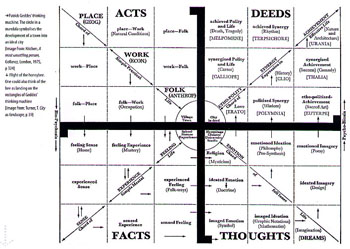
The left has a wonderful and rich history. Some of it is crazy, some impractical, some dangerous, but much is also full of insight, pertinent and surprisingly modern. Let’s rediscover and develop it instead of banging on about Stalin, the bloody Webbs and how socialism died with the fall of the Berlin Wall. The collapse of the Soviet Union finally interred the embalmed corpse of Stalinism. Libertarian left ideas, both Marxist and non-Marxist variants, remained unaffected; they detested Stalinism (and didn’t think much of the Webbs either). This is a living tradition with fascinating, and alive, thinkers and writers, not a relic from the age of the gramophone. And it is relevant - we are not quite as ‘modern’ as we like to think we are.
Finally, I have to mention the Drink-Soaked Trots, one of those “obsessed with their own ‘radical left’ identity, with ideological purity and with loyalty to the anachronistic ‘revolutionary’ principles of yesteryear”. Hang on a second. I am one! I post there under the moniker of the Big Fat Gadgie (ta Will). And what a diverse bunch we are. As well as bog standard bloggers like myself, there are distinguished authors and journalists from both sides of the Atlantic, and even a fine, prize wining poet. And though we have a common commitment to universal human emancipation, we love to quarrel about how it should take place. I am proud to contribute and even more proud that many of these wonderful writers have become my friends.
What has happened in the aftermath of 9/11 is that a section of the left woke up, and spotted that another section had drifted into an accommodation with Islamism and anti-Semitism, a trend that had been going on since the 60’s and 70’s. They promptly mounted a challenge. They haven’t comprehensively won, but now every egregious excrescence is met with reasoned argument and passionate scorn. It is hugely to everyone's credit. This fostered a new internationalism, countering pessimistic 'realism' with a wholehearted belief in human possibilities across the world.
All of this is excellent. However, my concern, expressed in recent posts, is that, after our exertions, we too begin to doze off. We get so comfortable attacking the left that we forget that we are left as well. We relax and, in doing so, we forget the grotesque injustices and inequities in even those societies that are liberal capitalist democracies. We forget the shantytowns and favellas, we forget environmental devastation and we forget that, if the current food crisis gets worse, millions of poor people will starve to death whilst I poke fun at government obesity strategies. Only connect.
So it is time to progress and I approach this as an optimist. I would argue that Socialism, in the broadest sense of the word (even Benjamin Tucker described himself as a socialist), has not died and we need to turn to our history to understand how diverse and rich a tradition it is. It is also a history that developed in a critical relationship with capitalism. Some wanted to tame it, others to replace it. With Stalinism firmly in the ground, let’s build on that critique; let’s support economic, as well as political and social, rights; let's fight complacency at home as well as oppression abroad; and, above all, let’s not sleepwalk into the cul-de-sac that is “the end of history”.
Wednesday, April 09, 2008
Bits and bobs
Bits
It is worth reading more excellent posts supporting A C Grayling's defence of liberal learning. First up is Freens of Springburn. Some of you may remember my regret at his announcement that he was going to stop blogging. I am delighted to say that, after a brief hiatus, this declaration actually marked a prolific return to activity. His blog remains a delight. Secondly, Shuggy makes the important point about narrowly vocational learning that "this model of education usually fails to deliver even the dismal targets it sets for itself". He gives his reason why, but I have another one too - it is bloody boring. Finally, Norm posts a devastating riposte from a computer scientist giving an instrumental defence of the humanities.
Bobs - or more accurately, Bob's (from Brockley that is)
Bob's post comments on the same piece by Marko Hoare that I alluded to here. I liked a lot of what he had to say. In particular, this struck me:
But my most important quibble is that the West, whatever that is, has all too often not been the embodiment of the values Hoare describes here as “Western”...
One of my favourite general histories of Europe is Mark Mazower's Dark Continent. It not only takes intellectual history seriously and includes Greece and the Balkans in its narrative, but it also stresses the fragility of European democracy. Let us not forget that one of Europe's exports has been Fascism. That does not mean that contemporary Western society, built on Fascism's defeat, isn't hugely better than the imagined worlds of the totalitarian mind and the all too real worlds of vicious tyrannies around the globe. What it reminds us is that our achievements are vulnerable and that there is an ambiguity that a hubristic pro-Western definition of the left does not capture. And political activists have never been good at ambiguity.
That is why I am uneasy at a definition of the left as simply, "the extension of the liberal-democratic order across the globe, through the politics of human rights, promotion of democracy, universal values and interventionism (not necessarily always military)". I would see it as axiomatic that included in the list are equality, economic security, social justice and the promotion of a democratic society with independent institutions, such as free trade unions, rather than simply a political democracy established through a representative state legislature. That is what would make it a left, rather than centrist, vision.
And
Nick Cohen on the Max Mosley affair
He had a little of my sympathy for proving the truth of P J O’Rourke’s assertion that, “no one has ever had a fantasy about being tied to a bed and sexually ravished by someone dressed as a liberal”.
Or so it seemed when the story broke. But within days a blushing Nick Clegg announced that he had had dozens of lovers. I’m now looking forward to next Sunday’s revelations about a Chelsea brothel where the clients demand that prostitutes talk dirty to them about the Lisbon Treaty before beating them black and blue with an Electoral Reform Society discussion paper.
And finally, from the incomparable Olly
Diana Inquest: We agree with verdict say relieved Illuminati.
It is worth reading more excellent posts supporting A C Grayling's defence of liberal learning. First up is Freens of Springburn. Some of you may remember my regret at his announcement that he was going to stop blogging. I am delighted to say that, after a brief hiatus, this declaration actually marked a prolific return to activity. His blog remains a delight. Secondly, Shuggy makes the important point about narrowly vocational learning that "this model of education usually fails to deliver even the dismal targets it sets for itself". He gives his reason why, but I have another one too - it is bloody boring. Finally, Norm posts a devastating riposte from a computer scientist giving an instrumental defence of the humanities.
Bobs - or more accurately, Bob's (from Brockley that is)
Bob's post comments on the same piece by Marko Hoare that I alluded to here. I liked a lot of what he had to say. In particular, this struck me:
But my most important quibble is that the West, whatever that is, has all too often not been the embodiment of the values Hoare describes here as “Western”...
One of my favourite general histories of Europe is Mark Mazower's Dark Continent. It not only takes intellectual history seriously and includes Greece and the Balkans in its narrative, but it also stresses the fragility of European democracy. Let us not forget that one of Europe's exports has been Fascism. That does not mean that contemporary Western society, built on Fascism's defeat, isn't hugely better than the imagined worlds of the totalitarian mind and the all too real worlds of vicious tyrannies around the globe. What it reminds us is that our achievements are vulnerable and that there is an ambiguity that a hubristic pro-Western definition of the left does not capture. And political activists have never been good at ambiguity.
That is why I am uneasy at a definition of the left as simply, "the extension of the liberal-democratic order across the globe, through the politics of human rights, promotion of democracy, universal values and interventionism (not necessarily always military)". I would see it as axiomatic that included in the list are equality, economic security, social justice and the promotion of a democratic society with independent institutions, such as free trade unions, rather than simply a political democracy established through a representative state legislature. That is what would make it a left, rather than centrist, vision.
And
Nick Cohen on the Max Mosley affair
He had a little of my sympathy for proving the truth of P J O’Rourke’s assertion that, “no one has ever had a fantasy about being tied to a bed and sexually ravished by someone dressed as a liberal”.
Or so it seemed when the story broke. But within days a blushing Nick Clegg announced that he had had dozens of lovers. I’m now looking forward to next Sunday’s revelations about a Chelsea brothel where the clients demand that prostitutes talk dirty to them about the Lisbon Treaty before beating them black and blue with an Electoral Reform Society discussion paper.
And finally, from the incomparable Olly
Diana Inquest: We agree with verdict say relieved Illuminati.
Tuesday, April 08, 2008
Learning to live
Norm was first to A C Grayling's splendid demolition of one of the new philistines (education is about "giving graduates the ability to excel in tired clichés the subjects we know will feed an information-based, technology-driven global economy"). However, it is still worth commenting approvingly on Grayling's advocacy of lifelong learning.
... we think education stops around the end of the second decade, and that people will then get on with the next stage of conformity, as both cogs in the wealth-production machine and consumers of its outputs. But education should be a lifelong endeavour. When it is, it is richly satisfying and keeps minds fresh and flexible, and maintains interest in the possibilities of the world.
I have lost count of the number of times I have heard the phrase 'adult education is my lifeline'. It really is life enhancing, transforming and, in some cases, life saving. Its sacrifice on the altar of employment skills is a major act of social and cultural vandalism. Grayling continues by picking up on a long running theme of this blog,
By one of those incomprehensible acts of stupidity of which governments are so frequently capable, our own has decided no longer to fund "equal or lower qualifications" in higher education, meaning that if you have a bachelor's degree in English literature and after 20 years in the workplace wish to study for one in computing or nursing, the government will not fund it. So much for the tens of thousands of people who, part-time, continue with or return to higher education to extend and refresh themselves by taking up new subjects and opening new horizons.
He actually gets something wrong, which makes the situation even more bizarre. The government is exempting Strategically Important Vocational Subjects (SIVS) and nursing is one of them. That means that you can become a nurse but not a computer scientist, an arbitrary division that will affect real lives.
In these times, every voice raised in support of learning for life, in both senses of the term, is welcome if we are to fight back against the triumph of a narrow and bureaucratic concept of education. Bravo Grayling!
... we think education stops around the end of the second decade, and that people will then get on with the next stage of conformity, as both cogs in the wealth-production machine and consumers of its outputs. But education should be a lifelong endeavour. When it is, it is richly satisfying and keeps minds fresh and flexible, and maintains interest in the possibilities of the world.
I have lost count of the number of times I have heard the phrase 'adult education is my lifeline'. It really is life enhancing, transforming and, in some cases, life saving. Its sacrifice on the altar of employment skills is a major act of social and cultural vandalism. Grayling continues by picking up on a long running theme of this blog,
By one of those incomprehensible acts of stupidity of which governments are so frequently capable, our own has decided no longer to fund "equal or lower qualifications" in higher education, meaning that if you have a bachelor's degree in English literature and after 20 years in the workplace wish to study for one in computing or nursing, the government will not fund it. So much for the tens of thousands of people who, part-time, continue with or return to higher education to extend and refresh themselves by taking up new subjects and opening new horizons.
He actually gets something wrong, which makes the situation even more bizarre. The government is exempting Strategically Important Vocational Subjects (SIVS) and nursing is one of them. That means that you can become a nurse but not a computer scientist, an arbitrary division that will affect real lives.
In these times, every voice raised in support of learning for life, in both senses of the term, is welcome if we are to fight back against the triumph of a narrow and bureaucratic concept of education. Bravo Grayling!
Monday, April 07, 2008
Pro and anti
Terry Glavin has a superb essay up at Z Word about the anti-Zionism of the Canadian left. It is an essential read. His analysis has much to inform a wider audience. I particularly liked his take on the contemporary ‘peace movement’ as reflecting a counter-cultural rather than a social-justice tradition.
He sees anti-war campaigners emerging from the mobilisations of the anti-globalisation movement and quotes Moishe Postone that these “did not express any sort of movement for progressive change”. I haven’t read Postone, but if that judgement is applied to the anti-globalisation movement as a whole it is harsh, certainly for a section of the movement. However, is easy to see how it could be seen in that way.
Firstly, the most visible face of the movement was presented by the decidedly counter-cultural methods of tactical frivolity. However amusing it is to see someone on stilts dressed as a giant pink fairy confronting baton-wielding riot police, it doesn’t inspire confidence in analytic rigour.
Secondly, the movement was partially a defensive one against a specific model of global capitalism that was not based on free markets, as often stated, but on markets fixed and governed by powerful multi-lateral institutions, which were rapidly transforming societies and destroying communities. In such a situation a movement against change is a progressive one.
Finally, the alternative political economy that the movement offered was disparate and inchoate, ranging from anarchist inspired localism to the more conventional left social democracy of those such as Susan George.
The anti-globalisation movement was always trying to shake off that label in favour of being known as the global justice movement and its heart was not the young activist, but the coalition of trade unions, landless peasants, small farmers, indigenous peoples, worker co-operatives, leftists and environmentalists. And this is where Terry’s essay really hits home. As the global justice movement morphed into the anti-war movement, where did this coalition go? It vanished to be replaced by groups of activists with a simplistic anti-Western sentiment. There was always a struggle by political activists to try and wrest control of such an iconic movement. The events following 9/11 allowed an unrepresentative section of the left, informed by “cultural codes” and “ideational packages”, as identified by Shulamit Volkov, rather than the real interests of the global poor, to take control and build an explicitly political anti-Western coalition.
It was a disaster, Islamists were embraced and the landless jettisoned. Iraqi trade unionists faced a barrage of abuse. The left flirted with anti-Semitism and conspiracy theory. It divorced itself from reality in a rather convenient way. There was no need for any great sacrifice for the 'struggle', just for the constant expression of the requisite anger. But we should not feel too smug. There is a parallel with some in the anti-totalitarian left. So when Marco Attila Hoare recently wrote that "the principal ideological division in global politics today" is "pro-Western vs anti-Western" I think that he too was oversimplifying. For the left, it is not about being reflexively pro or anti-Western. It is about standing with the poor, the oppressed and the exploited. It is about being consistently pro-social justice.
This is where Terry's piece is devastating. He writes that the left's obsession with anti-Zionism at the expense of social justice has meant that:
They have preempted the possibility of a legitimately robust international peace movement that might have found a way to intervene on behalf of ordinary Israelis, Palestinians, and Lebanese during the bloody crises of this century's first decade. And they have given courage and comfort to antisemitic fanatics and anti-modernist zealots from the crowded tenements of Gaza to the scorched opium fields of Kandahar.
In Canada, they have effectively infantilized important Canadian debates about the Afghanistan mission, upending these debates into a lurid discourse about American imperialism.
They have undermined labor-movement solidarity campaigns on behalf of the persecuted trade unionists of Iran. They have "problematized" the potential for Canadian leadership in a multilateral intervention on behalf of the suffering people of Darfur.
Reading Terry's article makes it perfectly clear that a left that simply defines itself purely in terms of its position vis a vis the West is not just a left that has lost its way, but one that has abandoned judgement and, thereby, integrity.
He sees anti-war campaigners emerging from the mobilisations of the anti-globalisation movement and quotes Moishe Postone that these “did not express any sort of movement for progressive change”. I haven’t read Postone, but if that judgement is applied to the anti-globalisation movement as a whole it is harsh, certainly for a section of the movement. However, is easy to see how it could be seen in that way.
Firstly, the most visible face of the movement was presented by the decidedly counter-cultural methods of tactical frivolity. However amusing it is to see someone on stilts dressed as a giant pink fairy confronting baton-wielding riot police, it doesn’t inspire confidence in analytic rigour.
Secondly, the movement was partially a defensive one against a specific model of global capitalism that was not based on free markets, as often stated, but on markets fixed and governed by powerful multi-lateral institutions, which were rapidly transforming societies and destroying communities. In such a situation a movement against change is a progressive one.
Finally, the alternative political economy that the movement offered was disparate and inchoate, ranging from anarchist inspired localism to the more conventional left social democracy of those such as Susan George.
The anti-globalisation movement was always trying to shake off that label in favour of being known as the global justice movement and its heart was not the young activist, but the coalition of trade unions, landless peasants, small farmers, indigenous peoples, worker co-operatives, leftists and environmentalists. And this is where Terry’s essay really hits home. As the global justice movement morphed into the anti-war movement, where did this coalition go? It vanished to be replaced by groups of activists with a simplistic anti-Western sentiment. There was always a struggle by political activists to try and wrest control of such an iconic movement. The events following 9/11 allowed an unrepresentative section of the left, informed by “cultural codes” and “ideational packages”, as identified by Shulamit Volkov, rather than the real interests of the global poor, to take control and build an explicitly political anti-Western coalition.
It was a disaster, Islamists were embraced and the landless jettisoned. Iraqi trade unionists faced a barrage of abuse. The left flirted with anti-Semitism and conspiracy theory. It divorced itself from reality in a rather convenient way. There was no need for any great sacrifice for the 'struggle', just for the constant expression of the requisite anger. But we should not feel too smug. There is a parallel with some in the anti-totalitarian left. So when Marco Attila Hoare recently wrote that "the principal ideological division in global politics today" is "pro-Western vs anti-Western" I think that he too was oversimplifying. For the left, it is not about being reflexively pro or anti-Western. It is about standing with the poor, the oppressed and the exploited. It is about being consistently pro-social justice.
This is where Terry's piece is devastating. He writes that the left's obsession with anti-Zionism at the expense of social justice has meant that:
They have preempted the possibility of a legitimately robust international peace movement that might have found a way to intervene on behalf of ordinary Israelis, Palestinians, and Lebanese during the bloody crises of this century's first decade. And they have given courage and comfort to antisemitic fanatics and anti-modernist zealots from the crowded tenements of Gaza to the scorched opium fields of Kandahar.
In Canada, they have effectively infantilized important Canadian debates about the Afghanistan mission, upending these debates into a lurid discourse about American imperialism.
They have undermined labor-movement solidarity campaigns on behalf of the persecuted trade unionists of Iran. They have "problematized" the potential for Canadian leadership in a multilateral intervention on behalf of the suffering people of Darfur.
Reading Terry's article makes it perfectly clear that a left that simply defines itself purely in terms of its position vis a vis the West is not just a left that has lost its way, but one that has abandoned judgement and, thereby, integrity.
Martyrdom operation
The Torygraph reports on death by blogging.
Those who have lost their health in their determination to sate their readers' interest are, after their fashion, martyrs to a worthy cause.
It is a noble sacrifice that I make dear reader, and solely for you.
Those who have lost their health in their determination to sate their readers' interest are, after their fashion, martyrs to a worthy cause.
It is a noble sacrifice that I make dear reader, and solely for you.
Thursday, April 03, 2008
Progress
John Denham has brilliantly solved the University funding crisis.
The super-rich are being encouraged to make multi-million-pound donations to their former universities in an attempt to recreate 19th-century levels of educational philanthropy and civic engagement.
Leaving aside the fact that there is a perfectly good system of equitable contribution called progressive taxation, which Labour seem unwilling to use, this would be an unexceptional exhortation if it were not for the following.
... from August 1 the Government will pledge to match donations, made in cash or in shares, over the next three years.
Just what institutions do you think that most of the super-rich attended? Scumbag Poly? No, of course not. Most went to the Russell Group, the wealthy elite. So the government is prepared to throw an extra subsidy to the richest institutions to bribe them to 'rescue' a few students from their class. And then how much is this to cost? £200 million is the estimate. Now the ending of the funding of students to study for a second qualification, which will badly damage part-time and adult education, is being done to save £100 million and it turns out that they have double that spare to throw at the wealthy.
I have another idea. Scrap both these god-forsaken schemes and gives us the combined £300 million to develop properly inclusive part-time education for everyone.
The super-rich are being encouraged to make multi-million-pound donations to their former universities in an attempt to recreate 19th-century levels of educational philanthropy and civic engagement.
Leaving aside the fact that there is a perfectly good system of equitable contribution called progressive taxation, which Labour seem unwilling to use, this would be an unexceptional exhortation if it were not for the following.
... from August 1 the Government will pledge to match donations, made in cash or in shares, over the next three years.
Just what institutions do you think that most of the super-rich attended? Scumbag Poly? No, of course not. Most went to the Russell Group, the wealthy elite. So the government is prepared to throw an extra subsidy to the richest institutions to bribe them to 'rescue' a few students from their class. And then how much is this to cost? £200 million is the estimate. Now the ending of the funding of students to study for a second qualification, which will badly damage part-time and adult education, is being done to save £100 million and it turns out that they have double that spare to throw at the wealthy.
I have another idea. Scrap both these god-forsaken schemes and gives us the combined £300 million to develop properly inclusive part-time education for everyone.
Tuesday, April 01, 2008
Sleeping stones
A new archaeological excavation is to take place at Stonehenge. And guess what the preparations involved?
Druids were also invited to give their blessing to disrupting the long sleep of the stones.
Yikes. What will happen when the stones wake up? Will they scare sheep? Attack tourists? Write to the papers to express disgust at the poor quality of the visitor centre and the traffic noise?
The surrender to obscurantist nonsense continues daily. I can't wait for the first Druid faith school.
Druids were also invited to give their blessing to disrupting the long sleep of the stones.
Yikes. What will happen when the stones wake up? Will they scare sheep? Attack tourists? Write to the papers to express disgust at the poor quality of the visitor centre and the traffic noise?
The surrender to obscurantist nonsense continues daily. I can't wait for the first Druid faith school.
Subscribe to:
Posts (Atom)